France as a Fairy Tale
Promise at DawnFrance as a Fairy Tale is the idealized country Nina Borisovskaia built through stories for her son, Romain Gary. It was at once a promised home, a storehouse of heroic images, and an inheritance of expectation: a place imagined as free, beautiful, and just before Gary knew it as a country of ordinary people and institutions. The fairy tale did not disappear when reality contradicted it. It shaped his loyalties, made exclusion painful, and gave him a standard by which to choose what France should mean.
A country made in a mother’s voice
Nina Borisovskaia’s authority over this imagined France rested less on a settled account of her own past than on the force of her telling. The family knew that she had been born in Kursk, the daughter of a Jewish watchmaker, and that she had been beautiful and married young. Her theatrical history remained uncertain: Ivan Mosjoukine, who had known her earlier, suggested that circumstances had prevented her talent from developing, while another account of her beginnings was much less flattering. Gary, however, remembered the voice, the laughter, the cheek pressed against his, and the perfume of lily-of-the-valley. Her storytelling left a more lasting mark than any verified stage career could have done.
She spoke French with a strong Russian accent, but kept the history of how she had learned it largely to herself, acknowledging only that she had been in Nice and Paris. To her son, she made France a distant land where beauty lay, dreams came true, men were free and equal, and artists were welcomed into the finest houses. Her descriptions carried the conviction of an intimate promise: Gary’s future, she insisted through the stories, belonged there. The country was not simply a destination. It was a world Nina Borisovskaia said she could already see, and invited her son to see with her.
The fairy tale on the refugee journey
The stories accompanied Gary through circumstances that sharply opposed their promise. In Moscow, he lived with his mother in a flat shared with other actors; later, they traveled west for three weeks in a cattle-and-goods train, with typhus among the dangers of displacement. At Lida, they were quarantined. They slept among a hundred refugees on straw at the railway station, and Gary remembered his mother rubbing his numbed fingers as she spoke of the country where his future lay. He wore camphor beads meant to protect him from lice, had his head shaved, and clung to a chamber pot he had carried from Moscow. These particulars of hardship did not interrupt the tale. They became its setting.
Nina Borisovskaia filled that setting with names and scenes: Bayard and Napoleon Bonaparte, Sarah Bernhardt and the stories of French literature, the shops of Maxim’s, the Bois de Boulogne, Austerlitz and Wagram, and a ball at the Opéra. Gary, exhausted and trying to stay awake, followed her gaze toward marvels he could not see beyond the dirty station wall. The contrast between the refugees’ immediate conditions and the imagined splendor is central to the idea: France’s power came from being narrated into view, not from anything the child could yet verify.
Years later, after the family had reached Nice and Gary had spent fifteen years in contact with French realities, his mother still saw the land of marvels she had carried with her. He could not share her untroubled ability to see around her what lived in her heart. His response was different: with the strength and courage of adulthood, he set himself the difficult task of making the fairy tale come true. The distinction mattered. The ideal remained, but it became work rather than a description of the country as it already was.
Childhood lessons and public symbols
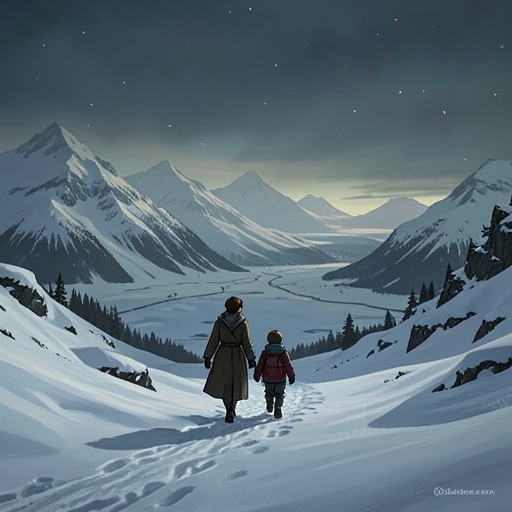
The fairy tale also entered the ordinary rituals of childhood. By the fire, while snow silenced the world outside, Nina Borisovskaia told France as other mothers might tell stories of fairy-tale characters. Gary imagined Jeanne d’Arc and liberty; he arranged lead soldiers on the nursery floor and reenacted the taking of the Bastille with a wooden sword. He learned to read through La Fontaine’s fables and came to feel that French was his mother tongue. His account stresses that even a prolonged residence in France could not simply undo the imaginative education of those years.
His mother’s belief in his future gave the ideal a personal consequence. When the boy showed no special gift for the careers she had first imagined for him, she turned to diplomacy and insisted that only the highest distinction would do: he would become an Ambassador of France. From the age of eight, she repeated the prediction during periods of hardship. The ambition was comic in its scale, but it also joined the country to maternal love and obligation. Gary’s imagined France was the place where his mother’s faith in him would be vindicated.
That faith could make the gap between story and life acute. During a grave childhood illness, Gary feared dying before he had supported his mother or fulfilled what she expected of him. He measured his unfinished life against the vanished prospects of becoming a celebrated musician or an ambassador. Later, he discovered that Nina Borisovskaia was diabetic after she collapsed at work from an insulin-related hypoglycemic episode; she had been giving herself injections each morning without telling him. In another crisis, she forbade the operation doctors proposed for his kidney. These episodes do not make France itself more real, but they show how the promised future was bound up with her care, her anxieties, and her determination that her son should survive to accomplish something worthy of it.
Collision with history and exclusion
The imagined country eventually met political reality. Gary recalls that, before he understood the dangers posed by Adolf Hitler and the Nazis, he trusted the French Army and its revered leaders. His mother had surrounded him with patriotic certainties, a private Maginot Line that held off doubt. Even the French defeat of 1870 had not entered his childhood account; he learned of it only at the lycée in Nice. The silence of France in the face of Hitler’s threats seemed to him at first a sign of composure rather than a reason for alarm.
After France’s defeat, the call to continue fighting by Charles de Gaulle on 18 June 1940 reached him in a way that joined public history to maternal memory. Gary heard in the appeal not only the general’s voice but the voice of the woman who had sold hats in Vilna and spoken of France in the same tone. He rallied without hesitation. The fairy tale thus became more than a childhood illusion: it supplied an emotional language for resistance when the country’s defeat threatened the very picture in which his allegiance had been formed.
Yet the ideal could not prevent institutional rejection. At the air-force school, Gary learned that he had been failed because he was Russian-born and had been naturalized too recently. A rule restricted flight-officer commissions to French-born candidates, those with French parents, or people naturalized for more than ten years; though the rule had been criticized as discriminatory and was said not to be applied, it was being enforced again. The decision made his claim to France’s identity collide with the state’s legal definition of eligibility. He could sincerely regard himself as French and still be treated as not French enough.
Belonging after disillusionment
Gary describes the rejection as a painful blow that unexpectedly made him feel truly French, as if the magic wand had finally worked. The change did not restore his childhood belief in French superiority. Instead, he understood that the French were not a separate or exceptional race, but people capable of foolishness and injustice like anyone else. France, in his revised understanding, contained many faces, noble and ugly, inspiring and repellent. Belonging required him to choose among them rather than surrender his judgment to the flag.
This more complicated allegiance did not cancel the earlier ideal. It changed its function. The fairy tale supplied a vision against which the actual country could be criticized, and a reason to remain committed without mistaking national symbols for moral perfection. Gary’s mother had imagined France as a finished realm of beauty and justice; he came to see it as an imperfect country whose best meanings had to be chosen and defended.
The concept gives the memoir its recurring tension between inheritance and correction. A refugee child’s France begins in stories told beside a fire and beside railway tracks, amid hunger, illness, and uncertainty. It later appears in school lessons, patriotic imagery, a wartime appeal, and the rules that deny Gary an officer’s commission. Each setting tests the same promise. The fairy tale endures not because reality confirms it, but because Gary turns the distance between the promised country and the encountered one into a demand: to make the ideal real without pretending that it already is.